
8.1. Introduction
8.1.6. What are the basic lifetime distribution models used for non-repairable populations?
8.1.6.2. |
Weibull |
The Weibull is a very flexible life distribution model with two parameters. It has CDF and PDF and other key formulas given by: $$ \begin{array}{ll} \mbox{PDF:} & f(t, \gamma, \alpha) = \frac{\gamma}{t} \left( \frac{t}{\alpha} \right)^\gamma e^{- \left( \frac{t}{\alpha} \right)^\gamma} \\ & \\ \mbox{CDF:} & F(t) = 1-e^{- \left( \frac{t}{\alpha} \right)^\gamma} \\ & \\ \mbox{Reliability:} & R(t) = e^{- \left( \frac{t}{\alpha} \right)^\gamma} \\ & \\ \mbox{Failure Rate:} & h(t) = \frac{\gamma}{\alpha} \left( \frac{t}{\alpha} \right) ^{\gamma-1} \\ & \\ \mbox{Mean:} & \alpha \Gamma \left(1+\frac{1}{\gamma} \right) \\ & \\ \mbox{Median:} & \alpha (\mbox{ln} \, 2)^{\frac{1}{\gamma}} \\ & \\ \mbox{Variance:} & \alpha^2 \Gamma \left( 1+\frac{2}{\gamma} \right) - \left[ \alpha \Gamma \left( 1 + \frac{1}{\gamma}\right) \right]^2 \end{array} $$
with \(\alpha\) the scale parameter (the Characteristic Life), \(\gamma\) (gamma) the Shape Parameter, and \(\Gamma\) is the Gamma function with \(\Gamma(N) = (N-1)!\) for integer \(N\).
The cumulative hazard function for the Weibull is the integral of the failure rate or $$ H(t) = \left( \frac{t}{\alpha} \right)^\gamma \,\, . $$
A more general three-parameter form of the Weibull includes an additional waiting time parameter \(\mu\) (sometimes called a shift or location parameter). The formulas for the 3-parameter Weibull are easily obtained from the above formulas by replacing \(t\) by (\(t-\mu)\) wherever \(t\) appears. No failure can occur before \(\mu\) hours, so the time scale starts at \(\mu\), and not 0. If a shift parameter \(\mu\) is known (based, perhaps, on the physics of the failure mode), then all you have to do is subtract \(\mu\) from all the observed failure times and/or readout times and analyze the resulting shifted data with a two-parameter Weibull.
NOTE: Various texts and articles in the literature use a variety of different symbols for the same Weibull parameters. For example, the characteristic life is sometimes called \(c\) (\(\nu\) = nu or \(\eta\) = eta) and the shape parameter is also called \(m\) (or \(\beta\) = beta). To add to the confusion, some software uses \(\beta\) as the characteristic life parameter and \(\alpha\) as the shape parameter. Some authors even parameterize the density function differently, using a scale parameter \(\theta = \alpha^\gamma\).
Special Case: When \(\gamma\) = 1, the Weibull reduces to the Exponential Model, with \(\alpha = 1/\lambda\) = the mean time to fail (MTTF).
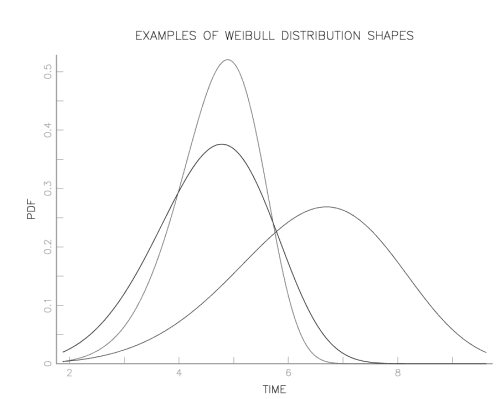
Depending on the value of the shape parameter \(\gamma\), the Weibull model can empirically fit a wide range of data histogram shapes. This is shown by the PDF example curves below.
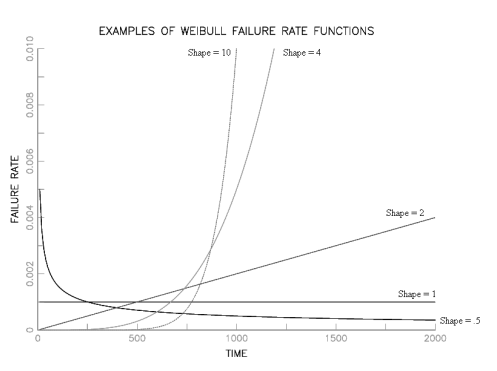
From a failure rate model viewpoint, the Weibull is a natural extension of the constant failure rate exponential model since the Weibull has a polynomial failure rate with exponent {\(\gamma - 1\)}. This makes all the failure rate curves shown in the following plot possible.
- Because of its flexible shape and ability to model a wide range of failure rates, the Weibull has been used successfully in many applications as a purely empirical model.
- The Weibull model can be derived theoretically as a form of
- Another special case of the Weibull occurs when the shape parameter is 2. The distribution is called the Rayleigh Distribution and it turns out to be the theoretical probability model for the magnitude of radial error when the \(x\) and \(y\) coordinate errors are independent normals with 0 mean and the same standard deviation.
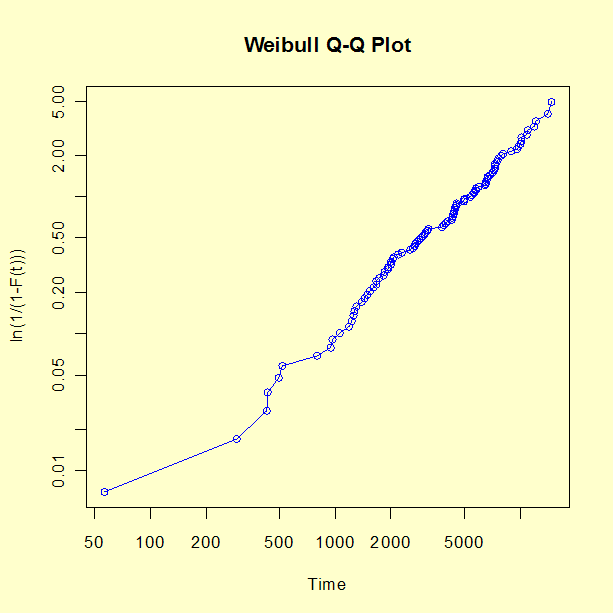 If the data follow a Weibull distribution, the points should follow a straight line.
We can comput the PDF and CDF values for failure time \(T\) = 1000, using the example Weibull distribution with \(\gamma\) = 1.5 and \(\alpha\) = 5000. The PDF value is 0.000123 and the CDF value is 0.08556.
Functions for computing Weibull PDF values, CDF values, and for producing probability plots, are found in both Dataplot code and R code.
