
8.1. Introduction
8.1.6. What are the basic lifetime distribution models used for non-repairable populations?
8.1.6.4. |
Lognormal |
The lognormal life distribution, like the Weibull, is a very flexible model that can empirically fit many types of failure data. The two-parameter form has parameters \(\sigma\) is the shape parameter and \(T_{50}\) is the median (a scale parameter).
Note: If time to failure, \(t_f\), has a lognormal distribution, then the (natural) logarithm of time to failure has a normal distribution with mean \(\mu\) = ln \(T_{50}\) and standard deviation \(\sigma\). This makes lognormal data convenient to work with; just take natural logarithms of all the failure times and censoring times and analyze the resulting normal data. Later on, convert back to real time and lognormal parameters using \(\sigma\) as the lognormal shape and \(T_{50} = e^\mu\) as the (median) scale parameter.
Below is a summary of the key formulas for the lognormal. $$ \begin{array}{ll} \mbox{PDF:} & f(t) = \frac{1}{\sigma t \sqrt{2 \pi}} \, e^{- \left( \displaystyle{\frac{1}{2 \sigma^2}} \right) \left( \mbox{ln } \displaystyle{t} - \mbox{ln } \displaystyle{T_{50}} \right)^2 } \\ & \\ \mbox{CDF:} & F(t) = \int_{0}^{T} \frac{1}{\sigma t \sqrt{2 \pi}} \, e^{- \left( \displaystyle{\frac{1}{2 \sigma^2}} \right) \left( \mbox{ln } \displaystyle{t} - \mbox{ln } \displaystyle{T_{50}} \right)^2} dt \\ & \\ & F(t) = \Phi \left( \frac{\mbox{ln }t - \mbox{ln } T_{50}}{\sigma}\right) \\ & \\ & \Phi(z) \mbox{ denotes the standard normal CDF.}\\ & \\ \mbox{Reliability:} & R(t) = 1-F(t) \\ & \\ \mbox{Failure Rate:} & h(t) = \frac{f(t)}{R(t)} \\ & \\ \mbox{Mean:} & T_{50} \, e^{\frac{1}{2} \sigma^2} \\ & \\ \mbox{Median:} & T_{50} \\ & \\ \mbox{Variance:} & T_{50}^2 \, e^{\sigma^2} \left(e^{\sigma^2} -1 \right) \end{array} $$
Note: A more general three-parameter form of the lognormal includes an additional waiting time parameter \(\theta\) (sometimes called a shift or location parameter). The formulas for the three-parameter lognormal are easily obtained from the above formulas by replacing \(t\) by \((t - \theta)\) wherever \(t\) appears. No failure can occur before \(\theta\) hours, so the time scale starts at \(\theta\) and not 0. If a shift parameter \(\theta\) is known (based, perhaps, on the physics of the failure mode), then all you have to do is subtract \(\theta\) from all the observed failure times and/or readout times and analyze the resulting shifted data with a two-parameter lognormal.
Examples of lognormal PDF and failure rate plots are shown below. Note that lognormal shapes for small sigmas are very similar to Weibull shapes when the shape parameter \(\gamma\) is large and large sigmas give plots similar to small Weibull \(\gamma\)'s. Both distributions are very flexible and it is often difficult to choose which to use based on empirical fits to small samples of (possibly censored) data.
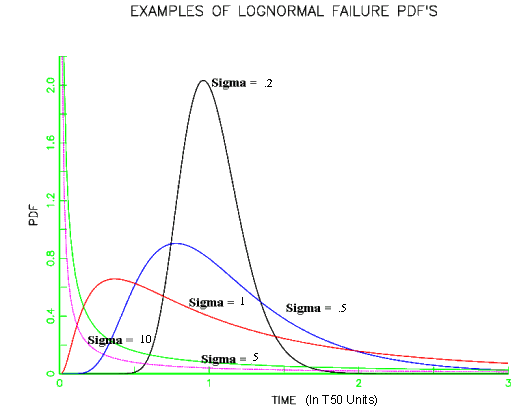
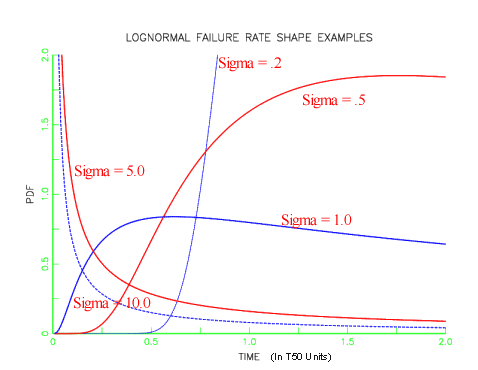
- As shown in the preceding plots, the lognormal PDF and failure rate shapes are flexible enough to make the lognormal a very useful empirical model. In addition, the relationship to the normal (just take natural logarithms of all the data and time points and you have "normal" data) makes it easy to work with mathematically, with many good software analysis programs available to treat normal data.
- The lognormal model can be theoretically derived under assumptions matching many failure degradation processes common to electronic (semiconductor) failure mechanisms. Some of these are: corrosion, diffusion, migration, crack growth, electromigration, and, in general, failures resulting from chemical reactions or processes. That does not mean that the lognormal is always the correct model for these mechanisms, but it does perhaps explain why it has been empirically successful in so many of these cases.
A brief sketch of the theoretical arguments leading to a lognormal model follows.
Applying the Central Limit Theorem to small additive errors in the log domain and justifying a normal model is equivalent to justifying the lognormal model in real time when a process moves towards failure based on the cumulative effect of many small "multiplicative" shocks. More precisely, if at any instant in time a degradation process undergoes a small increase in the total amount of degradation that is proportional to the current total amount of degradation, then it is reasonable to expect the time to failure (i.e., reaching a critical amount of degradation) to follow a lognormal distribution (Kolmogorov, 1941).A more detailed description of the multiplicative degradation argument appears in a later section.
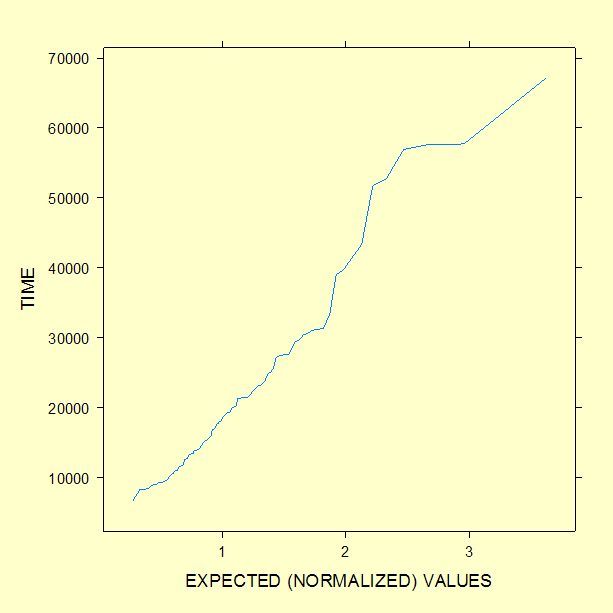
Functions for computing lognormal distribution PDF values, CDF values, failure rates, and for producing probability plots, are found in both Dataplot code and R code.
