
1.3. EDA Techniques
1.3.6. Probability Distributions
1.3.6.6. Gallery of Distributions
1.3.6.6.19. |
Poisson Distribution |
The formula for the Poisson probability mass function is
\( p(x;\lambda) = \frac{e^{-\lambda}\lambda^{x}} {x!} \mbox{ for } x = 0, 1, 2, \cdots \)
λ is the shape parameter which indicates the average number of events in the given time interval.
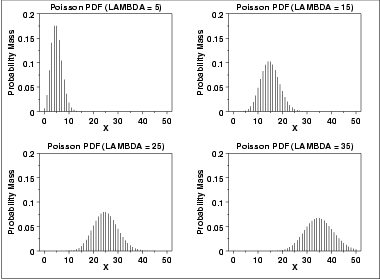
The following is the plot of the Poisson probability density function for four values of λ.
\( F(x;\lambda) = \sum_{i=0}^{x}{\frac{e^{-\lambda}\lambda^{i}} {i!}} \)
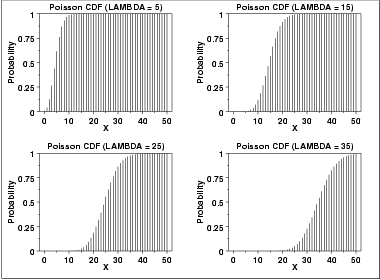
The following is the plot of the Poisson cumulative distribution function with the same values of λ as the pdf plots above.
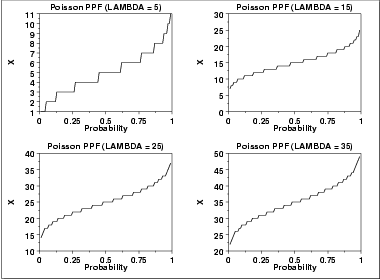
The following is the plot of the Poisson percent point function with the same values of λ as the pdf plots above.
| Mean | λ |
| Mode | For non-integer λ, it is the largest integer less than λ. For integer λ, x = λ and x = λ - 1 are both the mode. |
| Range | 0 to \(\infty\) |
| Standard Deviation | \( \sqrt{\lambda} \) |
| Coefficient of Variation | \( \frac{1} {\sqrt{\lambda}} \) |
| Skewness | \( \frac{1} {\sqrt{\lambda}} \) |
| Kurtosis | \( 3 + \frac{1} {\lambda} \) |
\(\tilde{\lambda} = \bar{X}\)
where \(\bar{X}\) is the sample mean.
