
1.4. EDA Case Studies
1.4.2. Case Studies
1.4.2.2. Uniform Random Numbers
1.4.2.2.3. |
Quantitative Output and Interpretation |
      Sample size  = 500
      Mean         =   0.5078304
      Median       =   0.5183650
      Minimum      =   0.0024900
      Maximum      =   0.9970800
      Range        =   0.9945900
      Stan. Dev.   =   0.2943252
Because the graphs of the data indicate the data may not be
normally distributed, we also compute two other statistics for the data,
the normal PPCC and the uniform PPCC.
      Normal PPCC  =   0.9771602
      Uniform PPCC =   0.9995682
The uniform
probability plot correlation
coefficient (PPCC) value is larger than the normal
PPCC value. This is evidence that the uniform distribution fits these
data better than does a normal distribution.
      Coefficient     Estimate     Stan. Error   t-Value
          B0        0.522923        0.2638E-01    19.82
          B1       -0.602478E-04    0.9125E-04    -0.66

      Residual Standard Deviation = 0.2944917
      Residual Degrees of Freedom = 498
The t-value of the slope
parameter, -0.66, is smaller than the critical value of
t0.975,498 = 1.96. Thus, we conclude that the slope is not
different from zero at the 0.05 significance level.
      H0:  σ12 = σ22 = σ32 = σ42
      Ha:  At least one σi2 is not equal to the others.

      Test statistic:  W = 0.07983
      Degrees of freedom:  k - 1 = 3
      Significance level:  α = 0.05
      Critical value:  Fα,k-1,N-k = 2.623
      Critical region:  Reject H0 if W > 2.623
In this case, the Levene test indicates that the variances are
not significantly different in the four intervals.
Another check is an autocorrelation plot that shows the autocorrelations for various lags. Confidence bands can be plotted using 95% and 99% confidence levels. Points outside this band indicate statistically significant values (lag 0 is always 1).
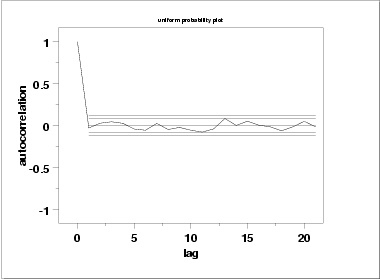
The lag 1 autocorrelation, which is generally the one of most interest, is 0.03. The critical values at the 5 % significance level are -0.087 and 0.087. This indicates that the lag 1 autocorrelation is not statistically significant, so there is no evidence of non-randomness.
A common test for randomness is the runs test.
      H0:  the sequence was produced in a random manner
      Ha:  the sequence was not produced in a random manner

      Test statistic:  Z = 0.2686
      Significance level:  α = 0.05
      Critical value:  Z1-α/2 = 1.96
      Critical region:  Reject H0 if |Z| > 1.96
The runs test fails to reject the null hypothesis that the data were
produced in a random manner.
A quantitative enhancement to the probability plot is the correlation coefficient of the points on the probability plot, or PPCC. For this data set the PPCC based on a normal distribution is 0.977. Since the PPCC is less than the critical value of 0.987 (this is a tabulated value), the normality assumption is rejected.
Chi-square and Kolmogorov-Smirnov goodness-of-fit tests are alternative methods for assessing distributional adequacy. The Wilk-Shapiro and Anderson-Darling tests can be used to test for normality. The results of the Anderson-Darling test follow.
      H0:  the data are normally distributed
      Ha:  the data are not normally distributed

      Adjusted test statistic:  A2 = 5.765
      Significance level:  α = 0.05
      Critical value:  0.787
      Critical region:  Reject H0 if A2 > 0.787
The Anderson-Darling test rejects the normality assumption because the
value of the test statistic, 5.765, is larger than the critical value
of 0.787 at the 0.05 significance level.
-
Yi = C + Ei
-
C = 0.499
95% confidence limit for C = (0.497,0.503)
 Analysis for 500 uniform random numbers

 1: Sample Size                           = 500

 2: Location
    Mean                                  = 0.50783
    Standard Deviation of Mean            = 0.013163
    95% Confidence Interval for Mean      = (0.48197,0.533692)
    Drift with respect to location?       = NO

 3: Variation
    Standard Deviation                    = 0.294326
    95% Confidence Interval for SD        = (0.277144,0.313796)
    Drift with respect to variation?
    (based on Levene's test on quarters
    of the data)                          = NO

 4: Distribution
    Normal PPCC                           = 0.9771602
    Normal Anderson-Darling               = 5.7198390
    Data are Normal?
      (as tested by Normal PPCC)          = NO
      (as tested by Anderson-Darling)     = NO

    Uniform PPCC                          = 0.9995683
    Uniform Anderson-Darling              = 0.9082221
    Data are Uniform?
      (as tested by Uniform PPCC)         = YES
      (as tested by Anderson-Darling)     = YES

 5: Randomness
    Autocorrelation                       = -0.03099
    Data are Random?
      (as measured by autocorrelation)    = YES

 6: Statistical Control
    (i.e., no drift in location or scale,
    data is random, distribution is
    fixed, here we are testing only for
    fixed uniform)
    Data Set is in Statistical Control?   = YES
