|
1.
Exploratory Data Analysis
1.4. EDA Case Studies 1.4.2. Case Studies 1.4.2.3. Random Walk
|
|||
| Goal |
The goal of this analysis is threefold:
|
||
| 4-Plot of Data |
|
||
| Interpretation |
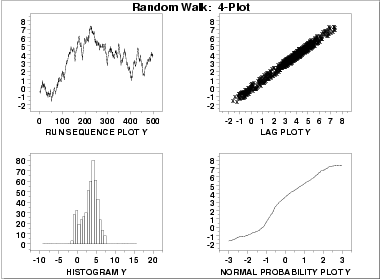
The assumptions are addressed by the graphics shown above:
When the randomness assumption is seriously violated, a time series model may be appropriate. The lag plot often suggests a reasonable model. For example, in this case the strongly linear appearance of the lag plot suggests a model fitting Yi versus Yi-1 might be appropriate. When the data are non-random, it is helpful to supplement the lag plot with an autocorrelation plot and a spectral plot. Although in this case the lag plot is enough to suggest an appropriate model, we provide the autocorrelation and spectral plots for comparison. |
||
| Autocorrelation Plot |
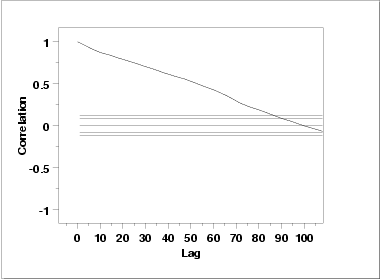
When the lag plot indicates significant non-randomness, it can be
helpful to follow up with a an
autocorrelation plot.
This autocorrelation plot shows significant autocorrelation at lags 1 through 100 in a linearly decreasing fashion. |
||
| Spectral Plot |
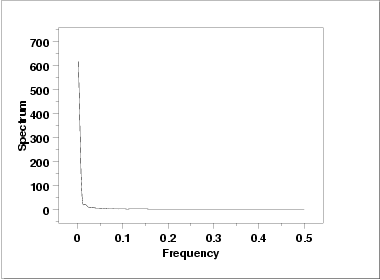
Another useful plot for non-random data is the
spectral plot.
This spectral plot shows a single dominant low frequency peak. |
||
| Quantitative Output | Although the 4-plot above clearly shows the violation of the assumptions, we supplement the graphical output with some quantitative measures. | ||
| Summary Statistics |
As a first step in the analysis, a table of summary statistics is
computed from the data. The following table, generated by
Dataplot, shows a typical set of
statistics.
SUMMARY
NUMBER OF OBSERVATIONS = 500
***********************************************************************
* LOCATION MEASURES * DISPERSION MEASURES *
***********************************************************************
* MIDRANGE = 0.2888407E+01 * RANGE = 0.9053595E+01 *
* MEAN = 0.3216681E+01 * STAND. DEV. = 0.2078675E+01 *
* MIDMEAN = 0.4791331E+01 * AV. AB. DEV. = 0.1660585E+01 *
* MEDIAN = 0.3612030E+01 * MINIMUM = -0.1638390E+01 *
* = * LOWER QUART. = 0.1747245E+01 *
* = * LOWER HINGE = 0.1741042E+01 *
* = * UPPER HINGE = 0.4682273E+01 *
* = * UPPER QUART. = 0.4681717E+01 *
* = * MAXIMUM = 0.7415205E+01 *
***********************************************************************
* RANDOMNESS MEASURES * DISTRIBUTIONAL MEASURES *
***********************************************************************
* AUTOCO COEF = 0.9868608E+00 * ST. 3RD MOM. = -0.4448926E+00 *
* = 0.0000000E+00 * ST. 4TH MOM. = 0.2397789E+01 *
* = 0.0000000E+00 * ST. WILK-SHA = -0.1279870E+02 *
* = * UNIFORM PPCC = 0.9765666E+00 *
* = * NORMAL PPCC = 0.9811183E+00 *
* = * TUK -.5 PPCC = 0.7754489E+00 *
* = * CAUCHY PPCC = 0.4165502E+00 *
***********************************************************************
The value of the autocorrelation
statistic, 0.987, is evidence of a very strong autocorrelation.
|
||
| Location |
One way to quantify a change in location over time is to
fit a straight line to the
data set using the index variable X = 1, 2, ..., N, with N denoting the
number of observations. If there is no significant drift in the
location, the slope parameter should be zero. For this data set,
Dataplot generates the following output:
LEAST SQUARES MULTILINEAR FIT
SAMPLE SIZE N = 500
NUMBER OF VARIABLES = 1
NO REPLICATION CASE
PARAMETER ESTIMATES (APPROX. ST. DEV.) T VALUE
1 A0 1.83351 (0.1721 ) 10.65
2 A1 X 0.552164E-02 (0.5953E-03) 9.275
RESIDUAL STANDARD DEVIATION = 1.921416
RESIDUAL DEGREES OF FREEDOM = 498
COEF AND SD(COEF) WRITTEN OUT TO FILE DPST1F.DAT
SD(PRED),95LOWER,95UPPER,99LOWER,99UPPER
WRITTEN OUT TO FILE DPST2F.DAT
REGRESSION DIAGNOSTICS WRITTEN OUT TO FILE DPST3F.DAT
PARAMETER VARIANCE-COVARIANCE MATRIX AND
INVERSE OF X-TRANSPOSE X MATRIX
WRITTEN OUT TO FILE DPST4F.DAT
The slope parameter, A1, has a
t value of 9.3 which is
statistically significant. This indicates that the slope
cannot in fact be considered zero and so the conclusion is that
we do not have constant location.
|
||
| Variation |
One simple way to detect a change in variation is with a
Bartlett test after dividing the
data set into several equal-sized intervals. However, the Bartlett
test is not robust for non-normality. Since we know this data set is
not approximated well by the normal distribution,
we use the alternative Levene
test. In partiuclar, we use the Levene test based on the median
rather the mean. The choice of the number of intervals is somewhat
arbitrary, although values of 4 or 8 are reasonable. Dataplot
generated the following output for the Levene test.
LEVENE F-TEST FOR SHIFT IN VARIATION
(ASSUMPTION: NORMALITY)
1. STATISTICS
NUMBER OF OBSERVATIONS = 500
NUMBER OF GROUPS = 4
LEVENE F TEST STATISTIC = 10.45940
FOR LEVENE TEST STATISTIC
0 % POINT = 0.0000000E+00
50 % POINT = 0.7897459
75 % POINT = 1.373753
90 % POINT = 2.094885
95 % POINT = 2.622929
99 % POINT = 3.821479
99.9 % POINT = 5.506884
99.99989 % Point: 10.45940
3. CONCLUSION (AT THE 5% LEVEL):
THERE IS A SHIFT IN VARIATION.
THUS: NOT HOMOGENEOUS WITH RESPECT TO VARIATION.
In this case, the Levene test indicates that the standard
deviations are significantly different in the 4 intervals
since the test statistic of 10.46 is greater than the 95%
critical value of 2.62. Therefore we conclude that the scale
is not constant.
|
||
| Randomness |
Although the lag 1 autocorrelation coefficient above clearly shows the
non-randomness, we show the output from a
runs test as well.
RUNS UP
STATISTIC = NUMBER OF RUNS UP
OF LENGTH EXACTLY I
I STAT EXP(STAT) SD(STAT) Z
1 63.0 104.2083 10.2792 -4.01
2 34.0 45.7167 5.2996 -2.21
3 17.0 13.1292 3.2297 1.20
4 4.0 2.8563 1.6351 0.70
5 1.0 0.5037 0.7045 0.70
6 5.0 0.0749 0.2733 18.02
7 1.0 0.0097 0.0982 10.08
8 1.0 0.0011 0.0331 30.15
9 0.0 0.0001 0.0106 -0.01
10 1.0 0.0000 0.0032 311.40
STATISTIC = NUMBER OF RUNS UP
OF LENGTH I OR MORE
I STAT EXP(STAT) SD(STAT) Z
1 127.0 166.5000 6.6546 -5.94
2 64.0 62.2917 4.4454 0.38
3 30.0 16.5750 3.4338 3.91
4 13.0 3.4458 1.7786 5.37
5 9.0 0.5895 0.7609 11.05
6 8.0 0.0858 0.2924 27.06
7 3.0 0.0109 0.1042 28.67
8 2.0 0.0012 0.0349 57.21
9 1.0 0.0001 0.0111 90.14
10 1.0 0.0000 0.0034 298.08
RUNS DOWN
STATISTIC = NUMBER OF RUNS DOWN
OF LENGTH EXACTLY I
I STAT EXP(STAT) SD(STAT) Z
1 69.0 104.2083 10.2792 -3.43
2 32.0 45.7167 5.2996 -2.59
3 11.0 13.1292 3.2297 -0.66
4 6.0 2.8563 1.6351 1.92
5 5.0 0.5037 0.7045 6.38
6 2.0 0.0749 0.2733 7.04
7 2.0 0.0097 0.0982 20.26
8 0.0 0.0011 0.0331 -0.03
9 0.0 0.0001 0.0106 -0.01
10 0.0 0.0000 0.0032 0.00
STATISTIC = NUMBER OF RUNS DOWN
OF LENGTH I OR MORE
I STAT EXP(STAT) SD(STAT) Z
1 127.0 166.5000 6.6546 -5.94
2 58.0 62.2917 4.4454 -0.97
3 26.0 16.5750 3.4338 2.74
4 15.0 3.4458 1.7786 6.50
5 9.0 0.5895 0.7609 11.05
6 4.0 0.0858 0.2924 13.38
7 2.0 0.0109 0.1042 19.08
8 0.0 0.0012 0.0349 -0.03
9 0.0 0.0001 0.0111 -0.01
10 0.0 0.0000 0.0034 0.00
RUNS TOTAL = RUNS UP + RUNS DOWN
STATISTIC = NUMBER OF RUNS TOTAL
OF LENGTH EXACTLY I
I STAT EXP(STAT) SD(STAT) Z
1 132.0 208.4167 14.5370 -5.26
2 66.0 91.4333 7.4947 -3.39
3 28.0 26.2583 4.5674 0.38
4 10.0 5.7127 2.3123 1.85
5 6.0 1.0074 0.9963 5.01
6 7.0 0.1498 0.3866 17.72
7 3.0 0.0193 0.1389 21.46
8 1.0 0.0022 0.0468 21.30
9 0.0 0.0002 0.0150 -0.01
10 1.0 0.0000 0.0045 220.19
STATISTIC = NUMBER OF RUNS TOTAL
OF LENGTH I OR MORE
I STAT EXP(STAT) SD(STAT) Z
1 254.0 333.0000 9.4110 -8.39
2 122.0 124.5833 6.2868 -0.41
3 56.0 33.1500 4.8561 4.71
4 28.0 6.8917 2.5154 8.39
5 18.0 1.1790 1.0761 15.63
6 12.0 0.1716 0.4136 28.60
7 5.0 0.0217 0.1474 33.77
8 2.0 0.0024 0.0494 40.43
9 1.0 0.0002 0.0157 63.73
10 1.0 0.0000 0.0047 210.77
LENGTH OF THE LONGEST RUN UP = 10
LENGTH OF THE LONGEST RUN DOWN = 7
LENGTH OF THE LONGEST RUN UP OR DOWN = 10
NUMBER OF POSITIVE DIFFERENCES = 258
NUMBER OF NEGATIVE DIFFERENCES = 241
NUMBER OF ZERO DIFFERENCES = 0
Values in the column labeled "Z" greater than 1.96 or less than
-1.96 are statistically significant at the 5% level.
Numerous values in this column are much larger than +/-1.96, so
we conclude that the data are not random.
|
||
| Distributional Assumptions | Since the quantitative tests show that the assumptions of randomness and constant location and scale are not met, the distributional measures will not be meaningful. Therefore these quantitative tests are omitted. | ||