1.
Exploratory Data Analysis
1.4.
EDA Case Studies
1.4.2.
Case Studies
1.4.2.5.
Beam Deflections
1.4.2.5.3.
|
Develop a Better Model
|
|
|
Sinusoidal Model
|
The lag plot and autocorrelation plot in the previous section
strongly suggested a sinusoidal model might be appropriate.
The basic sinusoidal model is:
\( Y_{i} = C + \alpha\sin{(2\pi\omega T_{i} + \phi)} + E_i \)
where C is constant defining a mean level, α
is an amplitude for the sine function, ω is the frequency,
Ti is a time variable, and
\(\phi\) is the phase. This sinusoidal model can be fit using
non-linear least squares.
To obtain a good fit, sinusoidal models require good starting values
for C, the amplitude, and the frequency.
|
|
Good Starting Value for C
|
A good starting value for C can be obtained by
calculating the mean of the data. If the data show a trend, i.e., the
assumption of constant location is violated, we can replace
C with a linear
or quadratic least squares fit. That is, the model becomes
\( Y_{i} = (B_0 + B_1*T_{i}) + \alpha\sin{(2\pi\omega T_{i} + \phi)}
+ E_i \)
or
\( Y_{i} = (B_0 + B_1*T_{i} + B2*T^{2}_{i}) + \alpha\sin{(2\pi\omega
T_{i} + \phi)} + E_i \)
Since our data did not have any meaningful change of location, we can
fit the simpler model with C equal to the mean. From
the summary output in the previous page, the mean is -177.44.
|
|
Good Starting Value for Frequency
|
The starting value for the frequency can be obtained from the
spectral plot, which shows the
dominant frequency is about 0.3.
|
|
Complex Demodulation Phase Plot
|
The
complex demodulation phase plot
can be used to refine this initial estimate for the frequency.
For the complex demodulation plot, if the lines slope from left to
right, the frequency should be increased. If the lines slope from
right to left, it should be decreased. A relatively flat (i.e.,
horizontal) slope indicates a good frequency. We could generate the
demodulation phase plot for 0.3 and then use trial and error
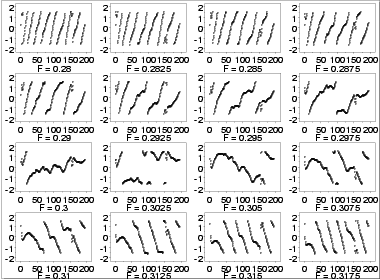
to obtain a better estimate for the frequency. To simplify this,
we generate 16 of these plots on a single page starting with
a frequency of 0.28, increasing in increments of 0.0025, and
stopping at 0.3175.
|
|
Interpretation
|
The plots start with lines sloping from left to right but gradually
change to a right to left slope. The relatively flat slope occurs for
frequency 0.3025 (third row, second column). The complex demodulation
phase plot restricts the range from \(\pi\)/2 to -\(\pi\)/2. This
is why the plot appears to show some breaks.
|
|
Good Starting Values for Amplitude
|
The
complex demodulation amplitude
plot is used to find a good starting value for the amplitude.
In addition, this plot indicates whether or not the amplitude is
constant over the entire range of the data or if it varies.
If the plot is essentially flat, i.e., zero slope, then it is
reasonable to assume a constant amplitude in the non-linear model.
However, if the slope varies over the range of the plot, we
may need to adjust the model to be:
\( Y_{i} = C + (B_0 + B_1*T_{i})\sin{(2\pi\omega T_{i} +
\phi)} + E_i \)
That is, we replace α with a function of time. A linear
fit is specified in the model above, but this can be replaced with a
more elaborate function if needed.
|
|
Complex Demodulation Amplitude Plot
|
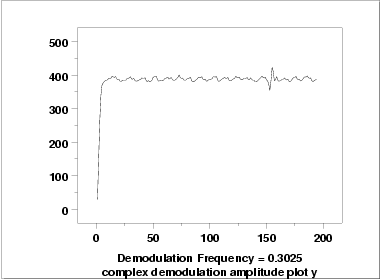
The complex demodulation amplitude plot for this data shows that:
- The amplitude is fixed at approximately 390.
- There is a short start-up effect.
- There is a change in amplitude at around x=160 that should
be investigated for an outlier.
In terms of a non-linear model, the plot indicates that fitting a single
constant for α should be adequate for this data set.
|
|
Fit Results
|
Using starting estimates of 0.3025 for the frequency, 390 for
the amplitude, and -177.44 for C, the following parameters were
estimated.
      Coefficient     Estimate     Stan. Error     t-Value
         C            -178.786        11.02         -16.22
         AMP          -361.766        26.19         -13.81
         FREQ         0.302596      0.1510E-03     2005.00
         PHASE         1.46536      0.4909E-01       29.85

      Residual Standard Deviation = 155.8484
      Residual Degrees of Freedom = 196
|
|
Model
|
From the fit results, our proposed model is:
\( \hat{Y}_i = -178.786 - 361.766[2\pi(0.302596)T_i + 1.46536] \)
We will evaluate the adequacy of this model in the next section.
|

