2.3. Calibration
2.3.5. Control of artifact calibration
2.3.5.1. Control of precision
2.3.5.1.1. |
Example of control chart for precision |
- Slow degradation in the balance
- Anomalous behavior at specific times

|
2.
Measurement Process Characterization
2.3. Calibration 2.3.5. Control of artifact calibration 2.3.5.1. Control of precision
|
|||
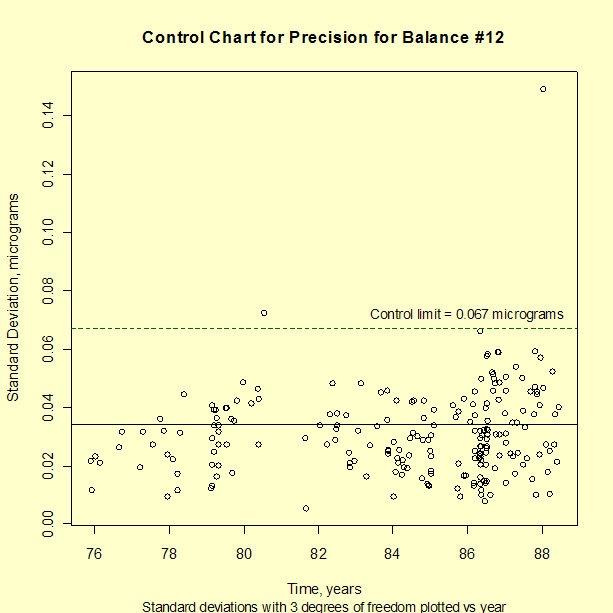
| Example of a control chart for precision of a mass balance | Mass calibrations usually start with the comparison of kilograms standards using a high precision balance as a comparator. Many of the measurements at the kilogram level that were made at NIST between 1975 and 1989 were made on balance #12 using a 1,1,1,1 calibration design. The redundancy in the calibration design produces estimates for the individual kilograms and a repeatability standard deviation with three degrees of freedom for each calibration run. These standard deviations estimate the precision of the balance. | ||
| Need for monitoring precision |
The precision of the balance is monitored to check for:
|
||
| Monitoring technique for standard deviations | The standard deviations over time and many calibrations are tracked and monitored using a control chart for standard deviations. The database and control limits are updated on a yearly or bi-yearly basis and standard deviations for each calibration run in the next cycle are compared with the control limits. In this case, the standard deviations from 117 calibrations between 1975 and 1985 were pooled to obtain a repeatability standard deviation with v = 3*117 = 351 degrees of freedom, and the control limits were computed at the 1 % significance level. | ||
| Control chart for precision |
The following control chart for precision for balance #12 can be
generated using both Dataplot code
and R code.
|
||
| Interpretation of the control chart | The control chart shows that the precision of the balance remained in control through the first five months of 1988 with only two violations of the control limits. For those occasions, the calibrations were discarded and repeated. Clearly, for the second violation, something significant occurred that invalidated the calibration results. | ||
| Further interpretation of the control chart | However, it is also clear from the pattern of standard deviations over time that the precision of the balance was gradually degrading and more and more points were approaching the control limits. This finding led to a decision to replace this balance for high accuracy calibrations. | ||
