Next Page Previous Page Home Tools & Aids Search Handbook
4. Process Modeling
4.6. Case Studies in Process Modeling
4.6.3. Ultrasonic Reference Block Study

4.6.3.4.

Weighting to Improve Fit

Weighting Another approach when the assumption of constant variance of the errors is violated is to perform a weighted fit. In a weighted fit, we give less weight to the less precise measurements and more weight to more precise measurements when estimating the unknown parameters in the model.
Finding An Appropriate Weight Function Techniques for determining an appropriate weight function were discussed in detail in Section 4.4.5.2.

In this case, we have replication in the data, so we can fit the power model

     
\begin{array}{ccl}
\ln{(\hat{\sigma}_i^2)} & = & \ln{(\gamma_1x_i^{\gamma_2})} \\
                         &   & \\
\mbox{\hspace*{0.55in}}  & = & \ln{(\gamma_1)} + \gamma_2\ln{(x_i})
\end{array}
to the variances from each set of replicates in the data and use  
w_i = \frac{1}{x^{\hat{\gamma}_2}_i}
for the weights.
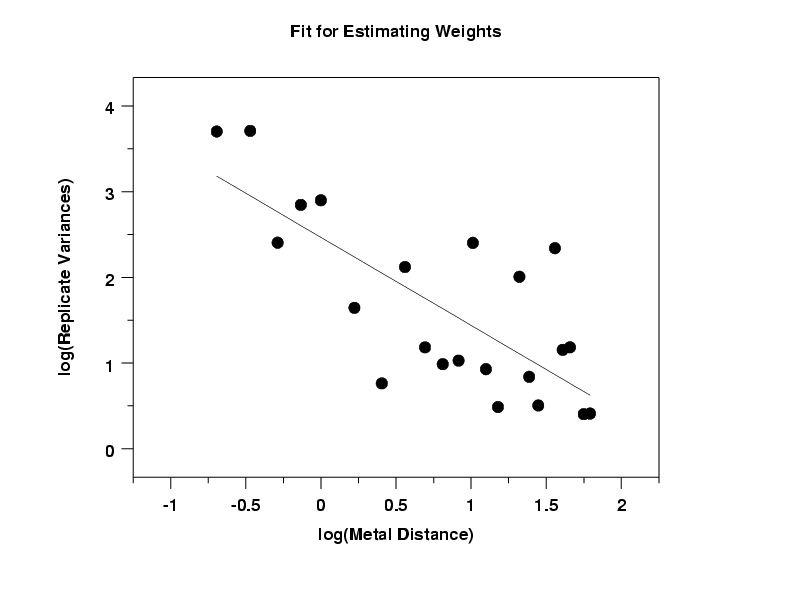
Fit for Estimating Weights Dataplot generated the following output for the fit of ln(variances) against ln(means) for the replicate groups. The output has been edited slightly for display.

LEAST SQUARES MULTILINEAR FIT
SAMPLE SIZE N       =       22
NUMBER OF VARIABLES =        1


PARAMETER ESTIMATES           (APPROX. ST. DEV.)    T VALUE
1  A0                   2.46872       (0.2186    )          11.
2  A1       XTEMP      -1.02871       (0.1983    )         -5.2

RESIDUAL    STANDARD DEVIATION =         0.6945897937
RESIDUAL    DEGREES OF FREEDOM =          20

plot of replicated variance against relicated means with fit

The fit output and plot from the replicate variances against the replicate means shows that the linear fit provides a reasonable fit, with an estimated slope of -1.03.

Based on this fit, we used an estimate of -1.0 for the exponent in the weighting function.
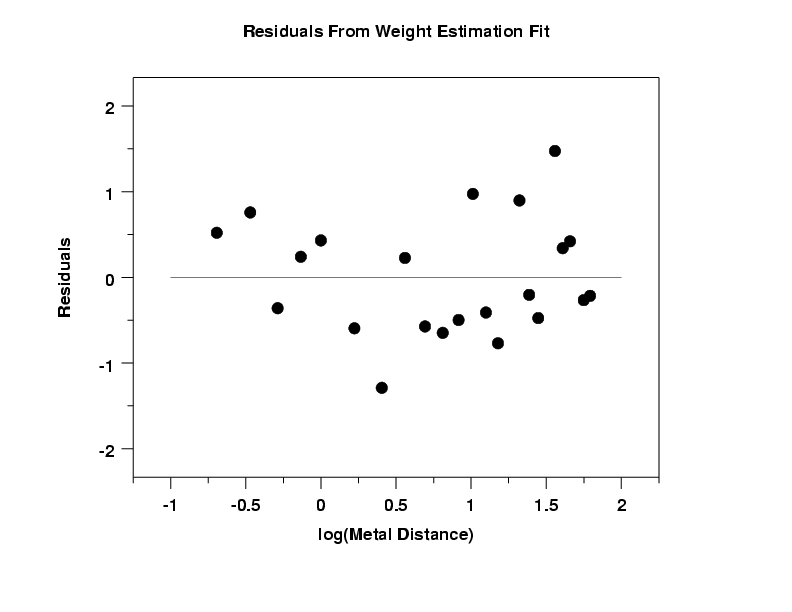
Residual Plot for Weight Function plot of residual values from fit for estimating weights reveals no obvious problems

The residual plot from the fit to determine an appropriate weighting function reveals no obvious problems.

Numerical Output from Weighted Fit Dataplot generated the following output for the weighted fit (edited slightly for display).

LEAST SQUARES NON-LINEAR FIT
SAMPLE SIZE N =      214
MODEL--ULTRASON =EXP(-B1*METAL)/(B2+B3*METAL)
REPLICATION CASE
REPLICATION STANDARD DEVIATION =     0.3281762600D+01
REPLICATION DEGREES OF FREEDOM =         192
NUMBER OF DISTINCT SUBSETS     =          22

FINAL PARAMETER ESTIMATES           (APPROX. ST. DEV.)    T VALUE
1  B1                  0.147046       (0.1512E-01)          9.7
2  B2                  0.528104E-02   (0.4063E-03)          13.
3  B3                  0.123853E-01   (0.7458E-03)          17.

RESIDUAL    STANDARD DEVIATION =         4.1106567383
RESIDUAL    DEGREES OF FREEDOM =         211
REPLICATION STANDARD DEVIATION =         3.2817625999
REPLICATION DEGREES OF FREEDOM =         192
LACK OF FIT F RATIO =       7.3183 = THE 100.0000% POINT OF THE
F DISTRIBUTION WITH     19 AND    192 DEGREES OF FREEDOM

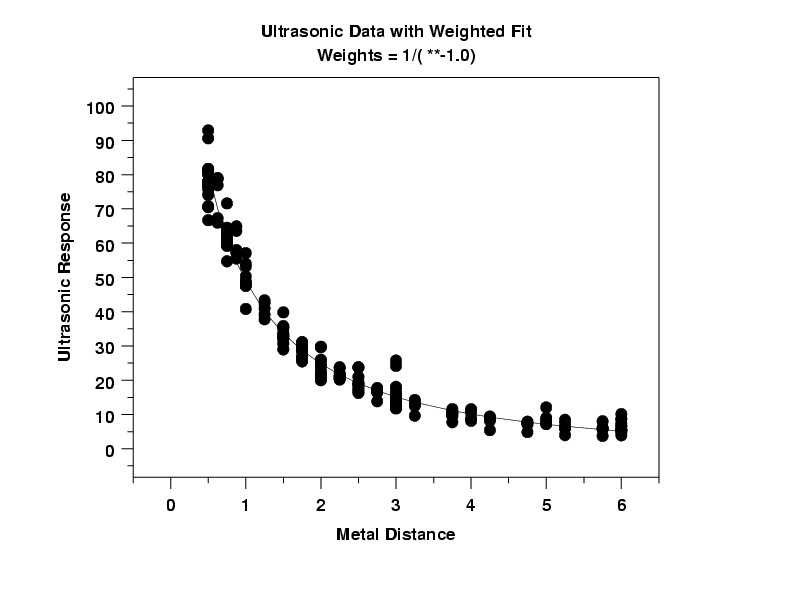
Plot of Predicted Values To assess the quality of the weighted fit, we first generate a plot of the predicted line with the original data.

plot of predicted values with raw data indicates a good fit

The plot of the predicted values with the data indicates a good fit. The model for the weighted fit is

     
y = \frac{\exp(-0.147x)}{0.00528 + 0.0124x}
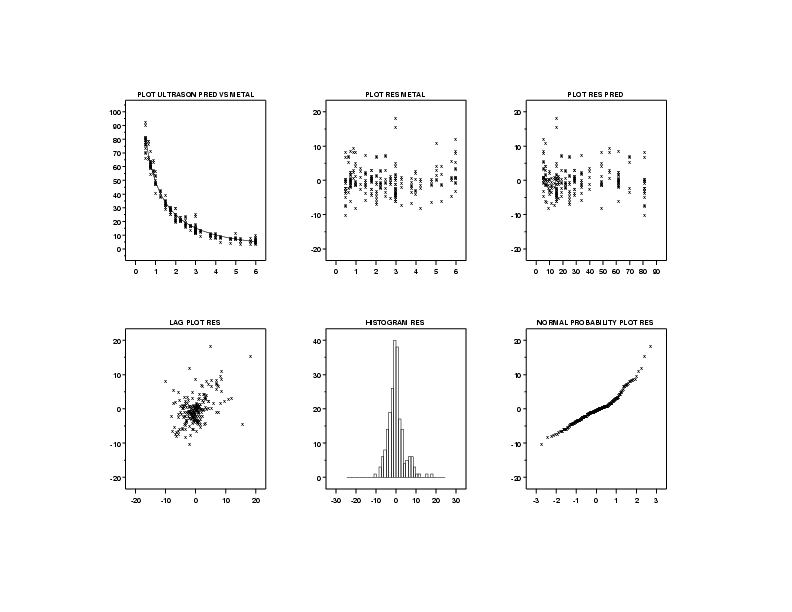
6-Plot of Fit 6-plot indicates regression assumptions satisfied

We need to verify that the weighted fit does not violate the regression assumptions. The 6-plot indicates that the regression assumptions are satisfied.
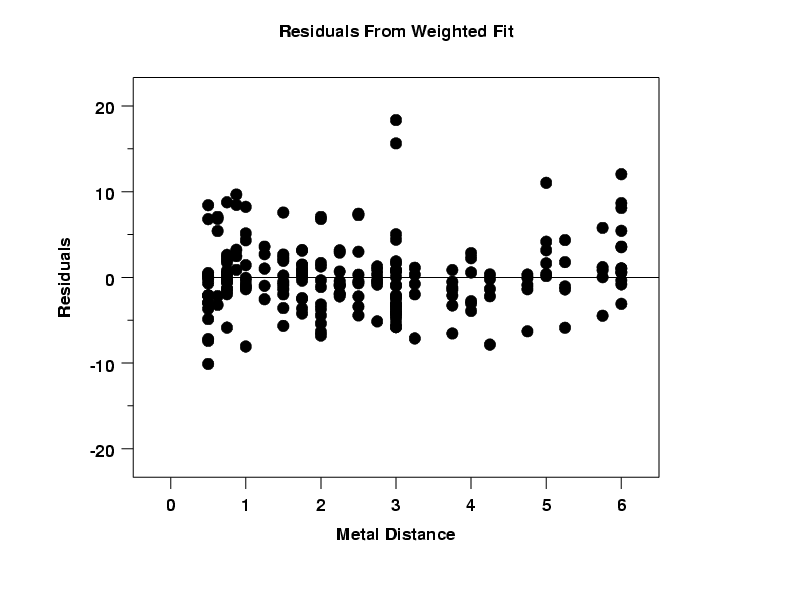
Plot of Residuals

plot of residuals versus predictor variable shows homogeneous variances for residuals

In order to check the assumption of equal error variances in more detail, we generate a full-sized version of the residuals versus the predictor variable. This plot suggests that the residuals now have approximately equal variability.

Home Tools & Aids Search Handbook Previous Page Next Page