5.
Process Improvement
5.5.
Advanced topics
5.5.3.
How do you optimize a process?
5.5.3.1.
Single response case
5.5.3.1.1.
|
Single response: Path of steepest ascent
|
|
|
Starting at the current operating conditions, fit a linear model
|
If experimentation is initially performed in a new, poorly understood
production process, chances are that the initial operating conditions
X1, X2, ...,Xk
are located far from the region where the factors achieve a maximum or
minimum for the response of interest, Y. A first-order model
will serve as a good local approximation in a small region close to
the initial operating conditions and far from where the process
exhibits curvature. Therefore, it makes sense to fit a simple
first-order (or linear polynomial) model of the form:
\( \hat{Y} = \beta_{0} + \beta_{1} X_{1} + \beta_{2} X_{2} +
\cdots + \beta_{k} X_{k} \)
Experimental strategies for fitting this type of model were discussed
earlier. Usually, a 2k-p fractional factorial
experiment is conducted with repeated runs at the current operating
conditions (which serve as the origin of coordinates in orthogonally
coded factors).
|
|
Determine the directions of steepest ascent and continue
experimenting until no further improvement occurs - then iterate the
process
|
The idea behind "Phase I" is to keep experimenting along the direction
of steepest ascent (or descent, as required) until there is no further
improvement in the response. At that point, a new fractional factorial
experiment with center runs is conducted to determine a new search
direction. This process is repeated until at some point significant
curvature in \( \hat{Y} \)
is detected. This implies that the operating conditions
X1, X2, ...,Xk are
close to where the maximum (or minimum, as required) of Y
occurs. When significant curvature, or lack of fit, is detected, the
experimenter should proceed with "Phase II". Figure 5.2 illustrates a
sequence of line searches when seeking a region where curvature exists
in a problem with 2 factors (i.e., k=2).
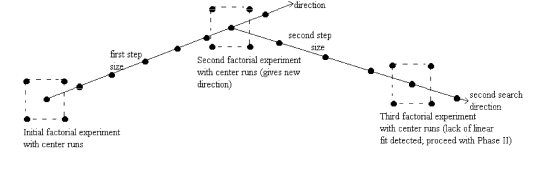
FIGURE 5.2: A Sequence of Line Searches for a 2-Factor
Optimization Problem
|
|
Two main decisions: search direction and length of step
|
There are two main decisions an engineer must make in Phase I:
- determine the search direction;
- determine the length of the step to move from the current
operating conditions.
Figure 5.3 shows a flow diagram of the different iterative tasks
required in Phase I. This diagram is intended as a guideline and
should not be automated in such a way that the experimenter has no
input in the optimization process.
|
|
Flow chart of iterative search process
|
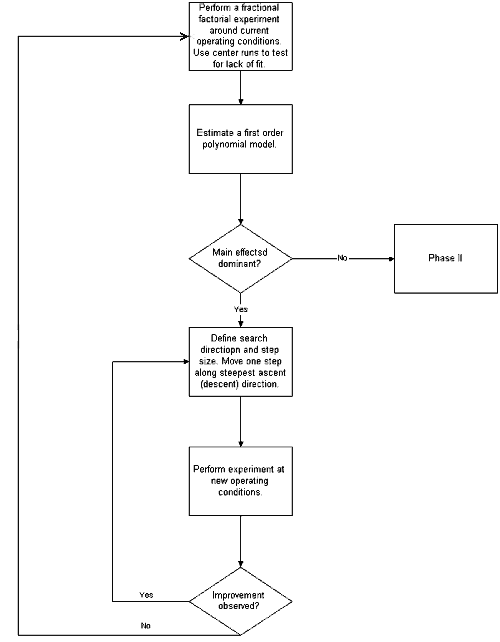 FIGURE 5.3: Flow Chart for the First Phase of the Experimental
Optimization Procedure
FIGURE 5.3: Flow Chart for the First Phase of the Experimental
Optimization Procedure
|
|
|
Procedure for Finding the Direction of Maximum Improvement
|
|
The direction of steepest ascent is determined by the gradient
of the fitted model
|
Suppose a first-order model (like above) has
been fit and provides a useful approximation. As long as lack of fit
(due to pure quadratic curvature and interactions) is very small
compared to the main effects, steepest ascent can be attempted. To
determine the direction of maximum improvement we use
- the estimated direction of steepest ascent, given by the
gradient of \( \hat{Y} \),
if the objective is to maximize Y;
- the estimated direction of steepest descent, given by the
negative of the gradient of \hat{Y} \),
if the objective is to minimize Y.
|
|
The direction of steepest ascent depends on the scaling convention
- equal variance scaling is recommended
|
The direction of the gradient, g, is given by the values
of the parameter estimates, that is,
g' = (b1, b2, ...,
bk).
Since the parameter estimates b1,
b2, ..., bk
depend on the scaling convention for the factors, the steepest ascent
(descent) direction is also scale dependent. That is, two
experimenters using different scaling conventions will follow different
paths for process improvement. This does not diminish the general
validity of the method since the region of the search, as given by
the signs of the parameter estimates, does not change with scale. An
equal variance scaling convention, however, is recommended. The coded
factors xi, in terms of the factors in the
original units of measurement, Xi,
are obtained from the relation
\( x_{i} = \frac{X_{i} -
\left( X_{\mbox{low}} + X_{\mbox{high}} \right)/2}
{\left( X_{\mbox{high}} - X_{\mbox{low}} \right)/2} \hspace{.5in}
i = 1, 2, \dots , k \)
This coding convention is recommended since it provides parameter
estimates that are scale independent, generally leading to a more reliable
search direction. The coordinates of the factor settings in the direction
of steepest ascent, positioned a distance \( \rho \)
from the origin, are given by:
|
|
Solution is a simple equation
|
This problem can be solved with the aid of an optimization solver
(e.g., like the solver option of a spreadsheet). However, in this
case this is not really needed, as the solution is a simple equation
that yields the coordinates
|
Equation can be computed for increasing values of

|
An engineer can compute this equation for different increasing values
of \( \rho \)
and obtain different factor settings, all on the steepest ascent
direction.
To see the details that explain this equation, see
Technical Appendix 5A.
|
|
|
Example: Optimization of a Chemical Process
|
|
Optimization by search example
|
It has been concluded (perhaps after a factor screening experiment)
that the yield (Y, in %) of a chemical process is mainly
affected by the temperature (X1, in  C)
and by the reaction time (X2, in minutes).
Due to safety reasons, the region of operation is limited to C)
and by the reaction time (X2, in minutes).
Due to safety reasons, the region of operation is limited to
50 ≤ X1 ≤ 250
150 ≤ X2 ≤ 500
|
|
Factor levels
|
The process is currently run at a temperature of 200
\( ^{\circ} \mbox{C} \)
and a reaction time of 200 minutes. A process engineer decides to run a
22 full factorial experiment with factor levels at
|
factor
|
low
|
center
|
high
|
|
|
X1
|
170
|
200
|
230
|
|
X2
|
150
|
200
|
250
|
|
|
Orthogonally coded factors
|
Five repeated runs at the center levels are conducted to assess lack
of fit. The orthogonally coded factors are
\( x_{1} = \frac{X_{1} - 200}{30} \hspace{.3in}\)
and
\( \hspace{.3in} x_{2} = \frac{X_{2} - 200}{50} \).
|
|
Experimental results
|
The experimental results were:
|
x1
|
x2
|
X1
|
X2
|
Y (= yield)
|
|
-1
|
-1
|
170
|
150
|
32.79
|
|
+1
|
-1
|
230
|
150
|
24.07
|
|
-1
|
+1
|
170
|
250
|
48.94
|
|
+1
|
+1
|
230
|
250
|
52.49
|
|
0
|
0
|
200
|
200
|
38.89
|
|
0
|
0
|
200
|
200
|
48.29
|
|
0
|
0
|
200
|
200
|
29.68
|
|
0
|
0
|
200
|
200
|
46.50
|
|
0
|
0
|
200
|
200
|
44.15
|
(The reader can download the data as a
text file.)
|
|
ANOVA table
|
The corresponding ANOVA table for a first-order polynomial model is
                 SUM OF        MEAN    F
SOURCE          SQUARES   DF  SQUARE  VALUE  PROB>F
MODEL          503.3035   2  251.6517 4.7972 0.0687
CURVATURE        8.2733   1    8.2733 0.1577 0.7077
RESIDUAL       262.2893   5   52.4579
  LACK OF FIT   37.6382   1   37.6382 0.6702 0.4590
  PURE ERROR   224.6511   4   56.1628

COR TOTAL      773.8660   8
|
|
Resulting model
|
It can be seen from the ANOVA table that there is no significant lack
of linear fit due to an interaction term and there is no evidence of
curvature. Furthermore, there is evidence that the first-order model
is significant. The resulting model (in the coded variables) is
\( \hat{Y} = 40.644 - 1.2925 x_{1} + 11.14 x_{2} \)
|
|
Diagnostic checks
|
The usual diagnostic checks show conformance to the regression
assumptions, although the R2 value is not very high:
R2 = 0.6504.
|
|
Determine level of factors for next run using direction of
steepest ascent
|
To maximize \( \hat{Y} \),
we use the direction of steepest ascent. The engineer selects
\( \rho \) = 1 since a point on the steepest ascent direction one unit
(in the coded units) from the origin is desired. Then from the equation
above for the predicted Y response, the coordinates of the factor
levels for the next run are given by:
\( \begin{array}{lcl}
x_{1}^{*} & = & \frac{\rho
\beta_{1}}{\sqrt{\sum_{j=1}^{2}{\beta_{j}^{2}}}} \\
& = & \frac{(1)(-1.2925)}{\sqrt{(-1.2925)^{2} + (11.14)^2}} \\
& = & -0.1152
\end{array}
\)
and
\( \begin{array}{lcl}
x_{2}^{*} & = & \frac{\rho
\beta_{2}}{\sqrt{\sum_{j=1}^{2}{\beta_{j}^{2}}}} \\
& = & \frac{(1)(11.14)}{\sqrt{(-1.2925)^{2} + (11.14)^2}} \\
& = & 0.9933
\end{array}
\)
This means that to improve the process, for every
(-0.1152)(30) = -3.456 \( ^{\circ} C \)
that temperature is varied (decreased), the reaction time should be
varied by (0.9933)(50) = 49.66 minutes.
|
|
|
|
|
|
Technical Appendix 5A: finding the factor settings on the steepest
ascent direction a specified distance from the origin
|
|
Details of how to determine the path of steepest ascent
|
The problem of finding the factor settings on the steepest
ascent/descent direction that are located a distance \( \rho \)
from the origin is given by the optimization problem,
\( \mbox{maximize} \hspace{.3in} \beta_{0} + \beta_{1}x_{1} +
\beta_{2}x_{2} + \cdots + \beta_{k}x_{k} \)
\( \mbox{subject to:} \hspace{.2in} \sum_{i=1}^{k}{x_{i}^{2}} \le
\rho^{2} \)
|
|
Solve using a Lagrange multiplier approach
|
To solve it, use a Lagrange multiplier approach. First, add a penalty
\( \lambda \)
for solutions not satisfying the constraint (since we want a direction
of steepest ascent, we maximize, and therefore the penalty is
negative). For steepest descent we minimize and the penalty term is
added instead.
\( \mbox{maximize} \hspace{.3in} L = b'x - \lambda(x'x - \rho^{2}) \)
Compute the partials and equate them to zero
|
|
Solve two equations in two unknowns
|
These two equations have two unknowns (the vector x and
the scalar \( \lambda \) )
and thus can be solved yielding the desired solution:
\( x^{*} = \rho \frac{b} {\parallel b \parallel} \)
or, in non-vector notation:
\( x^{*} = \rho \frac{b_{i}} {\sqrt{\sum_{j=1}^{k}{b_{j}^{2}}}}
\hspace{.3in} i = 1, 2, \ldots , k \)
|
|
Multiples of the direction of the gradient
|
From this equation we can see that any multiple \( \rho \)
of the direction of the gradient (given by
\( \frac{b}{\parallel b \parallel} \) )
will lead to points on the steepest ascent direction. For steepest
descent, use instead -bi in the
numerator of the equation above.
|

